Today, I’m talking about the ingredients that helped me to make it to the Olympics. This list of ingredients is highly personal, and probably vastly incomplete. These are the ones that come to mind as the most important throughout this past decade of running. I’d say they’re all equally important, except for the last one. This is the one that keeps me going, my why. Because without my peeps, what’s the point? 😉
HARD WORK
Running is quite simple. It’s a very repetitive motion, and one you have to do a lot to achieve excellence. The difficult thing is the balance between doing enough and overdoing it. First, let’s explore the latter. “Overdoing it” or overtraining is possibly to easiest way to get (seriously) injured or sick. It’s not that hard to train yourself into the ground. Just cram lots and lots of running into a short amount of time so it’s impossible to recover, and your body will break down one way or another. Mostly, this happens when athletes feel like they’re behind schedule towards a big goal and have to make up for lost training time (because of past injuries, or decreased training due to work or exams). Athletes that are not confident in their abilities or in their planning, tend to run too much to prove to themselves that they’re good enough. Lots of pitfalls, and I’ve had my fair share of experience with them.
But that does not mean that running a lot of miles is optional. If you’re committed to getting better, you will have to subject your body to excessive amounts of running. Yes, it takes years of training to responsibly reach a decent mileage, but once you’re there, it’s still a ridiculous investment of your time and energy. This comes at a price, though. The energy you have to put into your training, you won’t be able to put into other things. I worked as a physical therapist for two years, but when I decided to start training for the marathon, I understood that it would take a major shift in my mindset. I paused my job, and focused on running full-time. This brings us to the next ingredient: sacrifice.
SACRIFICE
It’s only a few years that I’m able to accept the consequences of taking running very seriously. Before, I was quite restless, always wondering if it’s worth it to make so many different sacrifices. It’s hard to underestimate the impact this focus has on every other aspect of my life. During my college years, I tried to balance running, studying and my social life. The first to suffer from that were my studies. I did okay, managed to pass most finals, but I didn’t excel at all. Running came first, making sure I did my training before thinking about picking up my books. And if I had to choose between studying and playing cards with my friends, I was happily putting down the books.
I was definitely not isolated, but the reality was that I was constantly saying “no” to all these fun events that you’re supposed to do when you’re in college. The parties, the late nights, the trips with friends. Other than during a short break between seasons, this was impossible to combine with serious training. So, I missed it. And that was sometimes very hard to take. I saw my friends having a great time, creating memories and sharing awesome experiences. And here I was, having this useless dream that no one really cares about but me, not nearly at the level of running I was hoping to be at. But seeing it before me, impossible to let it go. Creating a constant battle in my mind.
But I stuck with it, and my friends stuck around as well. 🙂
PATIENCE
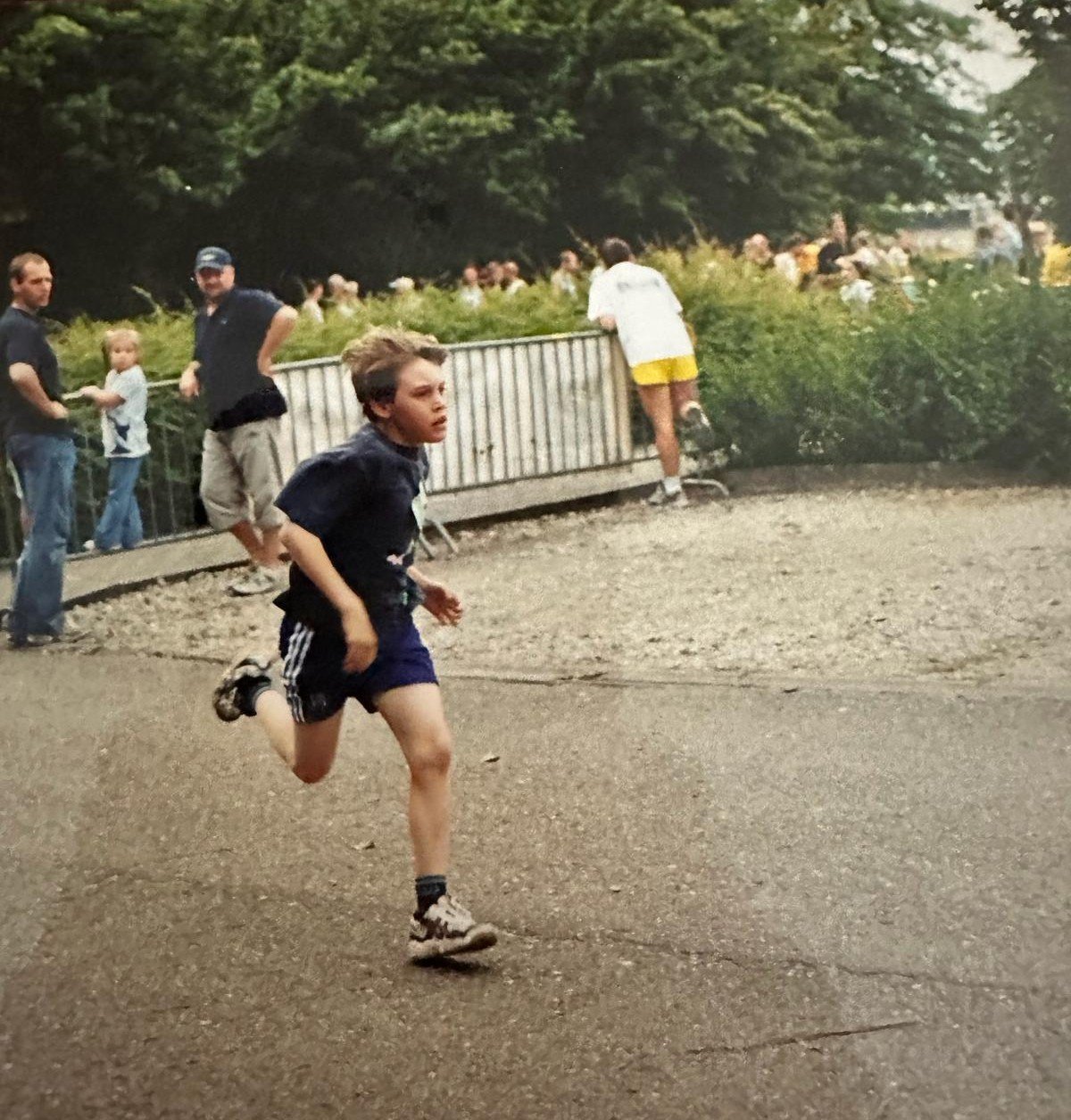
Running – like most endurance sports – is a sport of maturity. You will only be able to fully unlock your potential if you’ve given yourself time to develop. It takes years and years to fully develop the capacity of your heart and lungs to deliver oxygen to your muscles, as well as the ability of your muscles to use that oxygen to work efficiently. Talent shows quite instantly: everybody knows a kid from high school who could just keep running. Heck, I was that kid. But to perform on the big stage, even that kid has to train for more than a decade to reach the level of Olympic athletes. I was the fastest kid in my soccer team, and the fastest kid in my high school. I ran the school record of 15:21 over five kilometers. It took me another ten years to run the Olympic standard over the marathon distance, averaging 3:02 per kilometer, or more than 8 times a 5K in 15:10. The road towards that Olympic standard was not a smooth ride, littered with success and medals. It was a hard-fought battle, where I more than once seriously considered to call it quits. The one thing I keep coming back to when I think about how I got here, is quite simple: I stuck with it for long enough. I’ve had years where the progress I made was so excruciatingly slow, I was desperate. Constantly wondering if it’s time to move on to other things in life, but I just couldn’t let go of the unfinished business in the sport. And then things turned around for me. Not by radically changing my training, but it felt like my body finally absorbed all the training I’d been doing, and I’m able to access that fitness in races. It just clicked.
LUCK
Five weeks before Berlin Marathon, I got sick during the hardest part of my preparation. I was running big volume weeks, and my immune system was probably a little compromised. I still raced a half marathon one week later, and it went horribly. I flew straight to training camp in Switserland afterwards, and took the first days in the Swiss mountains to recover fully from the sickness and the race. I had another great three weeks of training after that, and was in the best shape of my life right on time. Sometimes, getting sick at the wrong moment can completely derail your preparation. You can be careful to protect yourself from infections, but some things are just out of our control. So yes, luck definitely plays its part in sports as well!
MAGIC
I was coming into the last 5 kilometers of the Berlin Marathon when I started to experience a side stitch. Subtle at first, but within a few hundred meters, it was so tough that it started to affect my breathing. I had been running by myself for about 10 kilometers at that point, staying right on 3’03″ per km, exactly the pace I needed to dip under the Olympic standard. And then suddenly my watch beeped for kilometer 38: 3 minutes, 10 seconds. In just one kilometer, I lost seven seconds on the pace I was supposed to be running, and the hardest part of the race was still ahead of me. For almost two hours, my mind was laser-focused on ticking off the right splits, one kilometer at a time. But when that watch beeped, putting me behind schedule for the first time that race, something changed. Suddenly, a thought started creeping in: “maybe not today”, “maybe we’ll have to wait for that magical day a little longer”, “just finish this race and next time we’ll get that Olympic standard”. Even during a race you’ve put your heart and soul into, your mind will try to convince you to take it easy, to push just a little less, to allow yourself some leeway. I remember these thoughts affecting my focus for like a minute, before I tried to shake it off and gather myself. I told myself to keep pushing, and look out for the last bottle station, at 40 kilometers. I managed to grab my black Maurten bottle with the blue tape. I took a few sips and a few deep breaths, before running over the timing system at 40 kilometers. With the little clarity that remained in my mind, I figured out I had 6 minutes and 40 seconds to run the Olympic standard or exactly 3 minutes per km over the last 2.195 kilometer. I hear two voices hysterically screaming my name in the distance. Within a few seconds, I realize it’s my girlfriend and my cousin and I instantly feel lighter. I don’t know why, but as I pass them with about 1km to go, I know the painful part is over. I am about to dig deeper than I ever have, but somehow my family and friends are going to do it with me. At 600 meters from the finish line, the Brandenburg Gate comes into sight, and I’m starting to push with every single fiber of my being.
The feeling is hard to describe, but if I had to it’d be something like this: It’s easy to disappoint myself, but with my family being there for me, I owe it to them to push as hard as I can. The only thing I would regret is crossing that finish line, knowing that I’ve allowed myself to back off, knowing I still had something to give. Coming onto the blue tape, I look up to the clock above and realize I’m going to make it. Passing the finishing line, I’m mostly just trying to wrap my head around what just happened. My career has come full circle.
YOUR PEEPS
They say it takes a village to raise a child. Same for an athlete. You don’t have to do it alone. In fact, you probably can’t. I rely on the people closest to me all the time. I’ve had to learn that asking for help is not a weakness. People actually love to help! This can be biking along on a hard workout or just asking for a phone call when you’re feeling down.
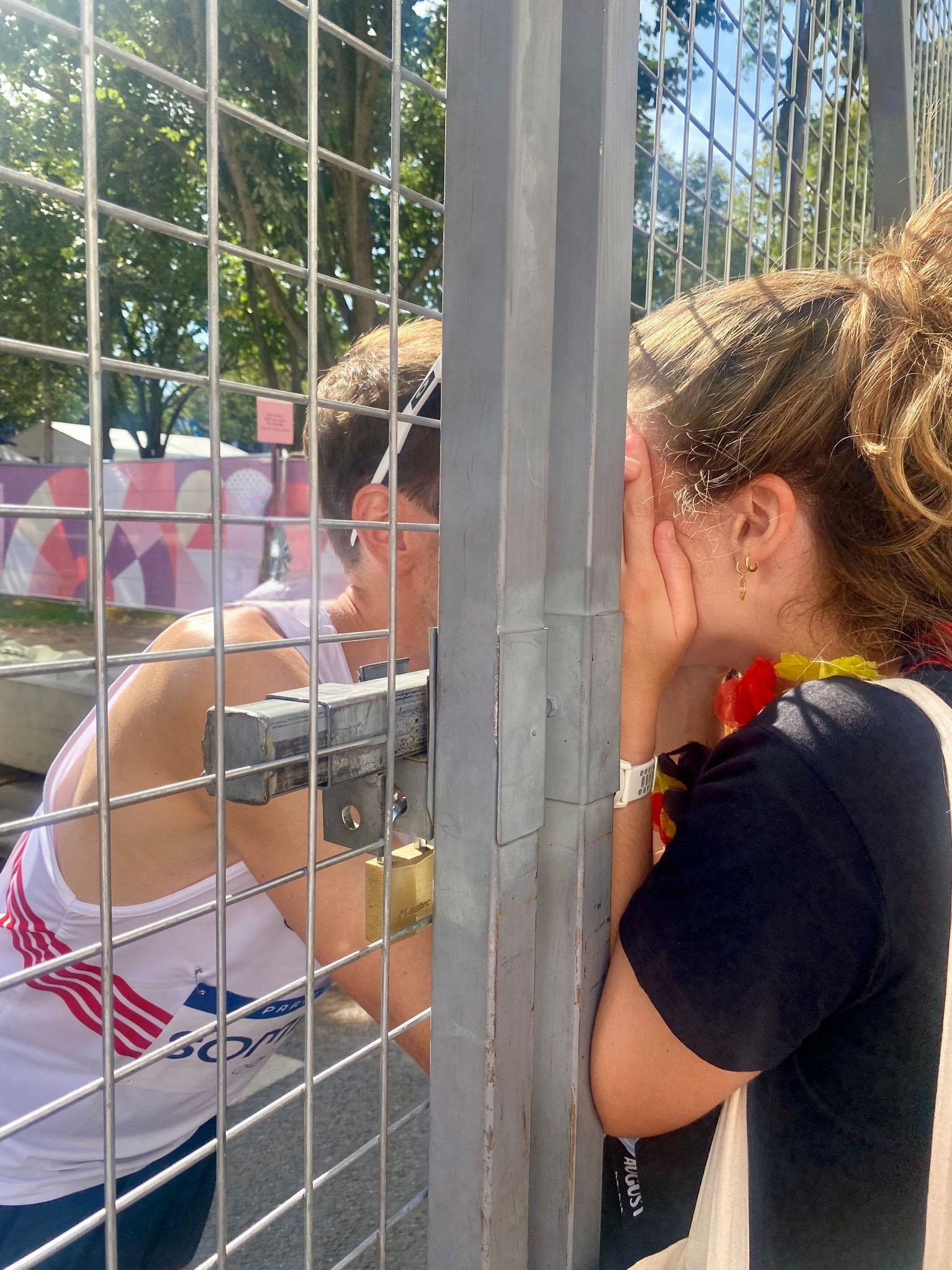
It’s the people that don’t necessarily text you when you’ve had a good race, but reach out when you’ve had a bad one. They’re the ones who know that you’ll get enough attention when you’re running well, but know you need a friend when you’re not. I have dinner with them after my races, to celebrate or to forget. They come together to cheer me on, even if they have to travel to Berlin, Seville, Dublin or Paris. I feel blessed to have such a great support system that I can celebrate the highs with and that I can rely on when this sport inevitably knocks you down.